무엇을 비교했나What the study compared
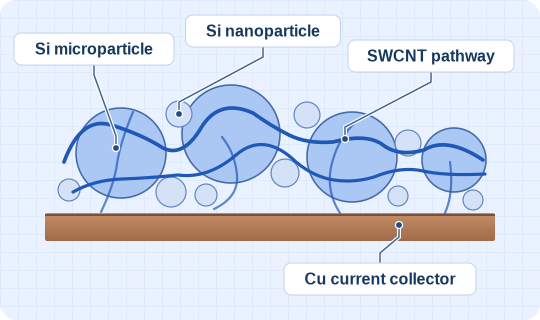
연구진은 실리콘 마이크로·나노 입자의 혼합비를 바꿔 서로 다른 충전 구조를 만들었습니다. 도전재로 논문에 명시된 베터리얼 S1304WK를 사용해 슬러리 유변 특성과 코팅, 전극 특성을 살폈습니다.The researchers varied the ratio of silicon micro- and nanoparticles to change their packing. They used Betterial S1304WK as the conductive additive and examined slurry rheology, coating and electrode behavior.
수분산 SWCNT 0.4 wt% (논문 표기)0.4 wt% SWCNT in water, as reported
실리콘 마이크로·나노 입자 혼합비Silicon micro-to-nanoparticle ratio
실리콘 음극 실험. 제품 간 비교 아님Silicon anode experiment, not a grade comparison
0.4 wt%는 연구에 사용된 분산액 농도이며, 건조 전극 내 첨가량이나 현재 판매 사양이 아닙니다.0.4 wt% describes the dispersion used in the study, not dry-electrode loading or a current commercial specification.
결과를 어디까지 읽을 수 있나What the result supports
연구진은 해당 시험에서 실리콘 입자 배합을 최적화했을 때 용량과 사이클 안정성이 개선됐다고 보고했습니다. 비교에서 달라진 것은 입자 배합이므로, 이 결과를 S1304WK 단독 효과로 볼 수는 없습니다.The authors reported improved capacity and cycling stability after optimizing the silicon particle blend in their experiments. Because the particle blend changed, the result does not isolate the effect of S1304WK.
내 전극에서 먼저 확인할 것What to check in your own electrode
- 활물질, 바인더, 고형분 및 코팅 조건을 맞춥니다.Match active material, binder, solids and coating conditions.
- 도전재를 비교할 때는 건조 CNT 첨가량을 동일하게 두고, 감량 효과는 별도로 검증합니다.Compare additives at the same dry CNT loading, then test lower loadings separately.
- 슬러리 유변 특성, 코팅 균일성·접착력, 전기 저항과 셀 사이클을 함께 확인합니다.Check slurry rheology, coating uniformity and adhesion, electrical resistance and cell cycling together.
이 항목들은 적용 검토를 위한 제안이며 추가 실험 결과가 아닙니다.These are suggested checks for your application, not additional study findings.